Blog

  • Learning Design In Practice

    In my latest #tiegrad class I was asked to consider why learning design is important and how it can be useful in my own practice.  Here are some of my thoughts:


    When I use robust learning design to explicitly plan, structure, and sequence learning experiences for and with my students I find the quality of the instructional time to be high, and the user experience more satisfying.  One example that comes to mind immediately are the resources, curriculum, and lesson plans I use from Free The Children.  When I first partnered with Free The Children, in 2010, I used their resources in my social studies classes to raise awareness of local and global issues, but instead of adapting the resources to suit the needs of my learners I rolled out the lesson plans from the box, verbatim, and they failed.


    Why did they fail?  They were after all well written, scaffolded appropriately, and supported with multimedia options, but that wasn’t enough.


    After persistently and feverishly struggling through several lessons I took the time to reevaluate the experience my students were having and made some changes.  In essence, I started the learning design process.  The lessons were bombing because they were not my lessons; they were someone else’s.  The first change I made was to restructure the content and make sure I fully understood what I wanted my students to learn.  Next I evaluated the learning needs of my students and quickly found out they had a very limited knowledge of the geographical world around them, so I helped to quickly fill some knowledge gaps.  Finally, and most importantly, I moved away from a lesson plan format where I shared information, and we worked on the gradual release of responsibly on a specific task, to a much more hands on method.  My students have learned that the best way of understanding social justice issues and working towards positive change in the world is by creating awareness, educating others, and taking direct action.  My students now hosts assemblies to educate the school on the importance of education, they hold movie nights to talk about the importance of clean water, and they indulge in a day of silence in support of child rights.  Robust learning design has proved helpful in increasing student engagement and motivation.


    Advantages of Learning Design

    • Can lead to student centered learning rather than teacher centered learning
    • Leads to differentiated learning – Blooms Taxonomy
    • Can connect learning to real-life situations
    • Keeps the learning experiences ‘honest’ – How does this lesson relate to the goal?
    • Creating learning experiences based on latest neuroscience and tailored towards how children best learn today


    My Learning Design

    One area of learning design that is most important to my own practice is differentiating the learning experience for my students.  Sometimes I use the excuse that I have such a challenging class with a variety of complex needs that I cannot possible create meaningful learning experiences for everyone, but with a more robust learning design plan I can reach more of my learners.  Through understanding the cultural, knowledge, and skills gaps in my learners I can tailor learning to suit the individual needs of all my learners in a more effective manner than trying to squeeze all learners down a path they may not have the skills and experience to navigate.

  • Education: Behind The Noise Of The ’21st Century Learner’

    In my #tiegrad class, I was recently asked to consider whether or not our current schools/teachers/curriculum are preparing students for the 21st century?

    I think it’s fair to say that schools, teachers, and curriculum want to meet the needs of their learners regardless of the century they occupy.  They want to produce independent thinkers who contribute to society in positive ways, and learners who are encouraged to reach their full potential.

    Are they doing enough?

    Probably not, but it isn’t from lack of trying.  Everyday I am surrounded by deeply passionate educators, who deliver curriculum in meaningful and innovative ways, work hard towards building robust relationships with students, in districts who desperately want to see successful children arriving at school doors every morning.

    In order for curriculum to meet the needs of its learners it cannot be revised every 4+ years.  It’s in the area of curriculum where I find educators excel, and the work they do is sometimes under appreciated.  They have become extremely skilled at using curriculum as a guide before tweaking, contorting, and manipulating its content to make it relevant for their learners.  I don’t know a single teacher who isn’t working their socks off at making curriculum relevant.  It might not follow current ‘trends’ in education but who’s to say that it’s not meaningful to the group it’s being shared with.

    By now it is unquestionable that our current education system was designed for a different era, and needs an overhaul.  Learners grouped by age instead of interest/ability, sat in desks for the majority of the day, learning a compartmentalized curriculum, and primarily focused on individual success and recognition.  The world is moving in a different direction and education is in danger of being left behind.  If our current education system operated in the business world, then it would have folded long ago.  In its defense, there isn’t the kind of money allotted to make the kind of sweeping changes that occur often in the corporate world.  Schools are asked to do more with less and strain is clear to see.  When high schools are so overpopulated that PE teachers are required to conduct their lessons in the hallways then there is an obvious problem.  Perhaps there are too many individual groups (Ministry of Education, school boards, school districts, DPACS, principals, parents, union, and teachers) within the system trying to advocate for their own methods of reform, that it is difficult to hear the message through the noise.  The British Columbia Ministry of Education is in the process of revising its curriculum through its much-touted BC Education Plan. Will it be enough?  Only time will tell whether it will support those asked to convey its new vision of a changing world and changing learner.  I agree with the BC Education Plan’s message that student’s need to be at the center of their learning.  In fact, the more I read about student centered learning from the likes of Angela Maiers’s The Passion Driven Classroom, Will Richardson’s Why School, and Daniel Pink’s Drive, the more I realize the importance of learner choice in education.  Learners need time in their weekly schedule to find their passions and follow their own learning path.  I particularly enjoyed watching Shelley Wright’s TED Talk about the power of student learning.  In it she talks about a pedagogical awaking under the guidance of Alex Couros.

    “For the first time I began to realize that maybe my students could construct their learning.  That learning is constructed in community, and that maybe they would be the centre of it, maybe they would have something to say about it.…”  Shelley Wright.

    Student centered learning promotes lifelong learning, stimulates creativity, fosters a healthy sense of inquiry, and leads to increased engagement in the subject matter.

    As I continue to shape and reshape my own pedagogy through the experiences I have at school, my own lifelong learning, and the professional networks I have developed, I have come to realize certain facts about learners in the 21st Century.  I know that curriculum needs to be relevant and meaningful to its users.  I know that learners need time to follow paths of inquiry, and be encouraged to take risks. I know that the social and emotional needs of my students need to be met before any learning can take place, and there is a unhealthy fear of failure in our schools.  Most importantly, a robust, flexible, and rigorous public education system is more important than ever.

  • Does Design Thinking Have A Place In Education?

    Design Cycle_Design Thinking for Education (1)


    In my latest #tiegrad course I have been tasked with better understanding design thinking, and to consider whether it could play a relevant part in my own instructional design process.  I wanted to share my initial findings as I seek a deeper understanding of the process.

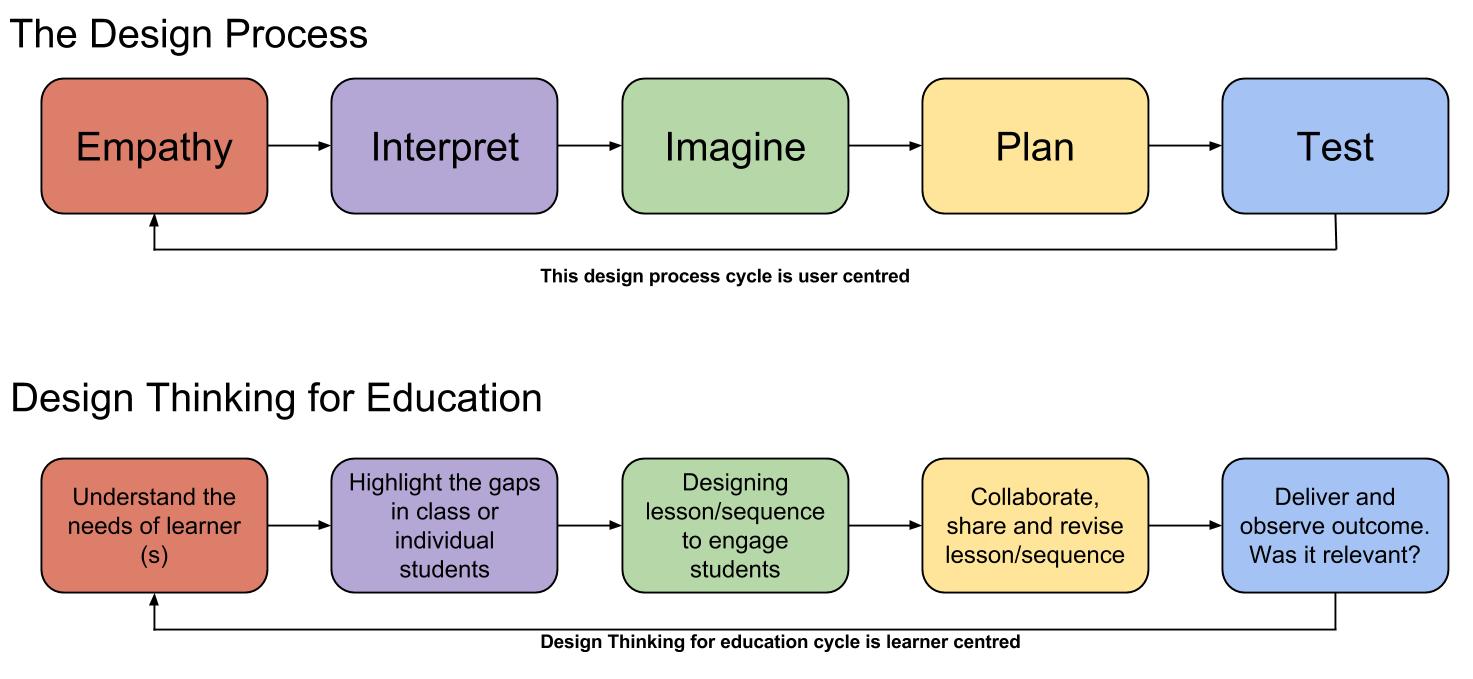
    If empathy, interpreting, imagining, planning, and testing are the principles of design thinking, then it is remarkably akin to the assessment cycle used in education.  They are both user centered, continuous, and intentional.  Perhaps design thinking is the new assessment cycle?  Regardless of your thoughts of the process of creating engaging, authentic, and relevant instruction in your classroom, I believe design thinking has a place in our education system, classrooms, and schools.

    If “Design has a set of tools and methods that can guide people to new solutions.” (Nussbaum, 2009) and mainstream public-school education in Canada is having difficulty understanding the needs of the latest entrants into its system, then surely we can borrow some ideas from design thinking to inspire a new generation of learner.

    I will be the first to admit that I struggle to consistently design learning experiences, which engage all my students.  I struggle with student apathy towards education, and I seem to focus so much of my day developing and maintaining relationships, understanding my learners, and meeting their socio-emotional needs that my current assessment practices need redesigning.  Can the design thinking cycle help?  I’m not sure yet, but I am certain that more time I spend with my learners working towards authentic, real life learning experiences the more engaged my class is, and the more satisfied I feel.

    I see design thinking working across the curriculum.  In social studies, design thinking is idea for addressing many social justice issues such as hunger, education, poverty, and unclean water.  These global issues need a new approach and  creative solutions.  The collaborative nature and user-centered approach of design thinking can help.  This PBS documentary shows design thinking at work by highlight the work done by Stanford University’s Institute of Design (aka the d.school) students who created products that may save thousands of lives in Bangladesh, Indonesia and other developing countries they visited.

    Teaching Students Design Thinking?

    In contrast to the benefits of design thinking as a teaching tool in education, I enjoyed reading Debbie Morrison’s blog posting Why ‘Design Thinking’ Doesn’t Work in Education.  As an elementary school teacher working in an inner-city school with a disproportionately high number of at-risk students, I fully agree with her argument that design thinking has a place in instructional design but not in student curriculum.  She argues that design thinking, “… requires one to think of a problem from unconventional, even unlikely perspectives…”  and could be too complex for our k-12 education system.  My students do not have the school experience or life experience to deal with such abstract thinking.  Morrison further states that our current learners

    “…have the creative confidence knocked out of them at an early age and little attention paid to developing their creative thinking skills thereafter. Any design thinking process would be greatly enhanced by people who have had the opportunity to hone their creative fluency, flexibility, originality and elaboration.”

    My learners are concrete learners.  How do we teach creative fluency, flexibility, and originality, when these qualities may not be supported/valued at home?


  • EDCI 335 Introduction to Learning Design

    Hello Everyone!

    My name is Christopher Lister.  Originally from England, I lived and worked in Canada for the last 15 years.  I am a little distracted in many areas of life right now as my partner and I are expecting our first child in the coming weeks. Together, we hope to figure out how to juggle the demands of school, work, and family life as the year progresses and our family grows.

    I have been directly involved in education for close to 10 years now, and I am looking forward to deepening my understanding of student engagement, motivation, and generally working on having more fun with the students I work with.  I work in the Chilliwack School District (SD#33) and for the last five years I have worked at Central Elementary Community School in downtown Chilliwack as a grade 5-6 teacher.  I enjoy the incredible freedom I have been given to plan activities, lessons, and learning opportunities that motivate and engage my students, but wonder if this freedom has meant that curriculum/learning design has taken a backseat.

    Instead of answering the question, “What would like to teach the world?” I feel more comfortable commenting on what I would like to share with the world.  In 2010 I was working at Central Elementary School, and my principal at the time, Scott Wallace, called me into his office one day to gauge my interest in an event called We Day.  He had arrange for me and my teaching partner to take our grade 6’s to the event in Vancouver.  At the time I did not recall the conversation as meaningfully as I do now, as this event, the spirit of We Day, and the impact it has had on the students who have bought into the movement is difficult to describe in words.  We Day is a movement to encourage youth to participate in social justice issue both locally and globally.  The message of We Day is loud and clear: There are many people in this world who, for reasons such as poverty, hunger, lack of education, lack of sufficient health care, and unclean water, are unable to reach their full potential in life.  When large numbers of youth get together, educated themselves, be empowered by mentors, and take action, they can create positive social change.  We Day changed the way I teach, it re energizes me when I get bogged down in curriculum, assessments, and meaningfully standardized testing, and it caused me to reevaluate how much I was contributing to the world around me.

    How will I share this with the world?  Well, I plan to continue to present opportunities for my students to participate in events that relate to positive social change through a partnership with Free The Children.  Personally, I plan to evaluate how much I contribute to the word around me, and look for opportunities to enhance and enrich my local community.  In fact, I am currently searching for the right opportunity to increase my volunteer time.

  • EDCI 338 Final Project Overview: Building a Restorative Community

    Restorative_Classroom_Practices_-_Community_-_Google__and_NewsNow__Manchester_United_News___Man_Utd_News___MUFC_Blog_Aggregator___Red_Devils_News___Every_Source__Every_Five_Minutes__24_7


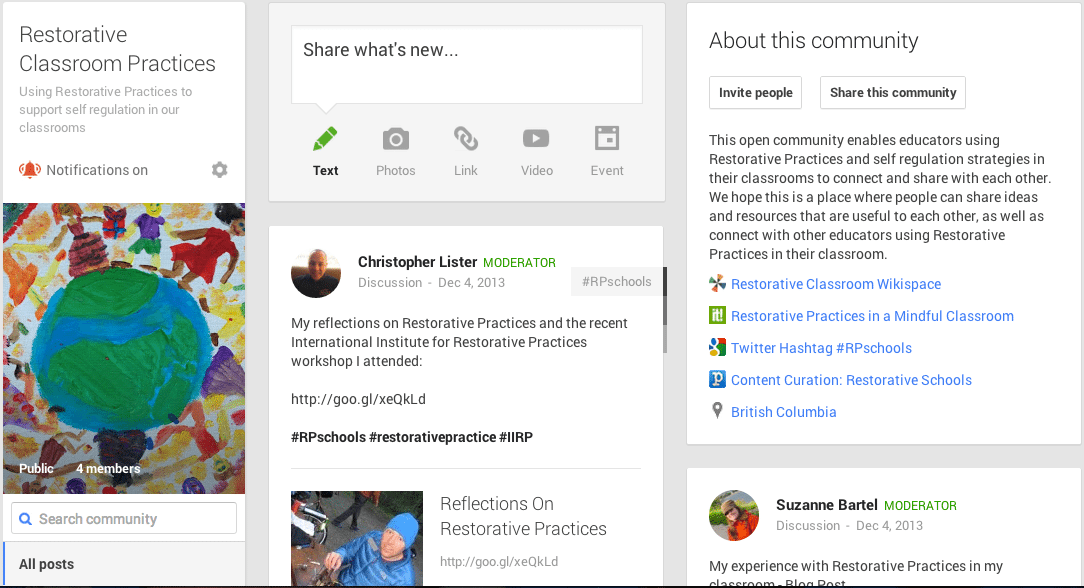
    Here is an overview of Suzanne Bartel and Christopher Lister’s joint EDCI 338 Professional Learning Project about Restorative Practices including Self Regulation.  

    Project Goal

    Our original goal was to create an online place for educators who are interested in using Restorative Practices in their classrooms to connect and share experiences.  Our plan was to take our existing Restorative Classroom Circles Wikispace and give it a facelift by adding the Restorative Practices philosophies, Compass of Shame, and the Social Discipline Window.  We also planned to engage our current Wikispace members and attract new members from our Twitter networks and local school district colleagues. With our existing restorative methods, we wanted to include more social and emotional learning into our curriculum.  We planned to introduce new concepts such as self-regulation (MindUP curriculum) into the Wikispace as a complementary addition to classroom circles.     


    Adaptations of our Goal: The Learning is in the Journey, not the Project

    This morning, we read a tweet from Mardelle Sauerborn that said “Cool how the projects are secondary to the journey.”  We couldn’t sum it up better ourselves!  Throughout our journey on this project, we have been constantly growing and learning in our EDCI #338 class discussions, school district collaboration group, Restorative Practices workshop, and our personal experiences with Restorative Practices in our classrooms.

    After creating a polldaddy survey to elicit feedback from our Wikispace members and talking to colleagues already using Restorative Practices in their classrooms, we realized that we were not having much success using our Wikispace as a collaborative tool. We started to wonder if we were using the right platform to create a collaborative environment.  In one of our EDCI 338 sharing classes, we were introduced to the idea of building a Google+ Community from Jane Rees and Allison Galloway.  This platform meant that people could participate in our community without becoming a member.  They could also add their own content and participate in online conversations. At this point, we decided that our Wikispace might be best left as a resource for implementing Restorative Practices, and a Google+ Community could be used to encourage collaboration.

    One interesting part of our learning journey occurred when we tried to deepen our understanding of Restorative Practices.  Several Google searches for “restorative practices” returned little useful information outside of International Institute for Restorative Practices.  We knew there was content out there but we had difficulty finding it.  Our original plan was use Diigo has a tool to collect and share bookmarks on the topic.  We attended a Hangout on Diigo hosted by Ed Tech Mentors Network and found that although it is a useful tool, it is limited in its ability to generate and evaluate content in the same that specific curation tools like Paper.li, Pearl Trees, and Scoop.it can.  We really liked the magazine style layout and ease of use that Scoop.it offered.         


    Actions Taken:


    Further Extensions to Project

    • After attending our Restorative Practices workshop, we realized the importance of explicitly teaching students the restorative process through storytelling.  We plan on creating a simple restorative storybook, embedding into our community, and potentially creating an electronic copy to be published on iTunes. Thanks to the expertise of Liane and Michelle


  • Reflections On Restorative Practices

    Ever felt so busy putting out ‘fires’ in your classroom or dealing with challenging behaviour and classroom management issues that you felt a lack of personal connection with your students?

    I have!


    On the flip side,  have you ever felt such a strong connection with your class that you felt that you could challenge them to tackle the toughest learning obstacles without fear and anxiety?

    I have felt this way too!


    Right now I am somewhere between these two extremes.  Restorative Practices has been both my nemesis and saviour along the way.

    One area of my own teaching practice that I have been focusing on this school year is building a stronger classroom community where students feel supported and support each other, where students can show vulnerability and feel safe to take risks, and where we are accountable for our actions and learn from our mistakes.  I am a firm believer that the social and emotional needs of my learners need to be met first before any academic learning and growth can occur.  That’s why I have been using the Restorative Practices framework in my classroom for over three years.

    Since 2010 I have been following the Restorative Practices framework with mixed success.  Occasionally, I experience real and meaning classroom discussions, personal student growth, and culture change in my classroom, but more often than not, I have felt that my students just going through the motions.  Before attending the recent International Institute of Restorative Practices workshop in Port Coquitlam my understanding of this framework had plateaued and it was evident I was struggling to see the same value I had seen earlier in my career.

    Halfway through the first day I suddenly realized what had been missing.  Bruce Schenk, director of IIRP Canada, shared some images from a picture book titled, A Restorative Story: Mary Finds Some Money about a girl named Mary who stole some money from her next door neighbour, and it suddenly clicked.  Not since the first year of implementation had I actually taken the time to properly introduce the design of Restorative Practices, or explained why this way of being was so important.  As an intermediate teacher, I know that students learn a great deal from storytelling combined with visual cues.  Soon after I returned from the conference I ordered a copy, and I am excited to share it with my students. I think it will help them to understand that building and rebuilding relationships is the essence of our community.

    “Culture is like a story book; change

    the stories and you change the

    culture” – Unknown quote

    The conference was also useful to refresh my understanding of two key concepts of restorative practices.  The Compass of Shame, based on Dr. Donald Nathanson’s work, explains how people react to shame.  Ever get the response, “It wasn’t me it was …” or the silent treatment from a student when you ask them what happened? That could be shame!  I learned that shame is not good or bad it just is.  We all experience shame to varying degree but it is how we deal with that is most important.  Nathanson explains that people who experience shame show it in one or more of the following ways; attack self, withdraw, avoid, or attack others.  Those who do not have opportunities to express shame in a safe and supportive environment may become disconnected from their community, whereas those who work within the Restorative Practices framework have a space to express their emotions and can lessen the intensity of them.

    The Social Discipline Window, the work of Australian criminologist John Braithwaite, refers to the way we work with people, or in my situation how to work with students, staff, and families.  It works on the simple principle that people reacted better to leadership when leadership works ‘with’ people rather than does ‘to’ or ‘for’ them.  When I work ‘with’ students, I involve them in the decision making process and hold them accountable for their actions.  The environment is high in support and high in expectations.  This relatively simple graphic, now embedded in my mind, serves as a gentle reminder of the educator and person I strive to be.

    “Human beings are happier, more cooperative and productive, and more likely to make positive changes in their behavior when those in positions of authority do things with them, rather than to them or for them.” John Braithwaite


    With renewed energy I have made some plans for the future of Restorative Practices in my classroom:

    1. Return to explicitly teaching the restorative framework using Mary’s Story as an example, and remind students that the classroom is a place for building and rebuilding relationships.

    2. Attempt, in a more formal manner, to directly link restorative practices to an increase in student engagement and achievement.

    3. Continue to use classroom circles to connect each morning, and start to implement more academic circles.

    4. To be more mindful of using restorative language in all aspects of my teaching, work, and life.

  • Content Curation: Finding The Needles in the Haystacks

    Digital Content Curation

    In my #TIEgrad class, I have been learning about the value of digital content curation.  I used to think I had pretty strong curation skills because I used Diigo as a tool to collect and store important links.  Fortunately, having had the opportunity to deepen my understanding of content curation I have found the quality of content I now collect and share has increased significantly.  The process of curation is a noble one. Curating content on a particular subject also helps others find those needles in the haystack.

    According to Wikipedia:

    Digital curation is the selection, preservation, maintenance, collection and archiving of digital assets.

    Effective Content Curation

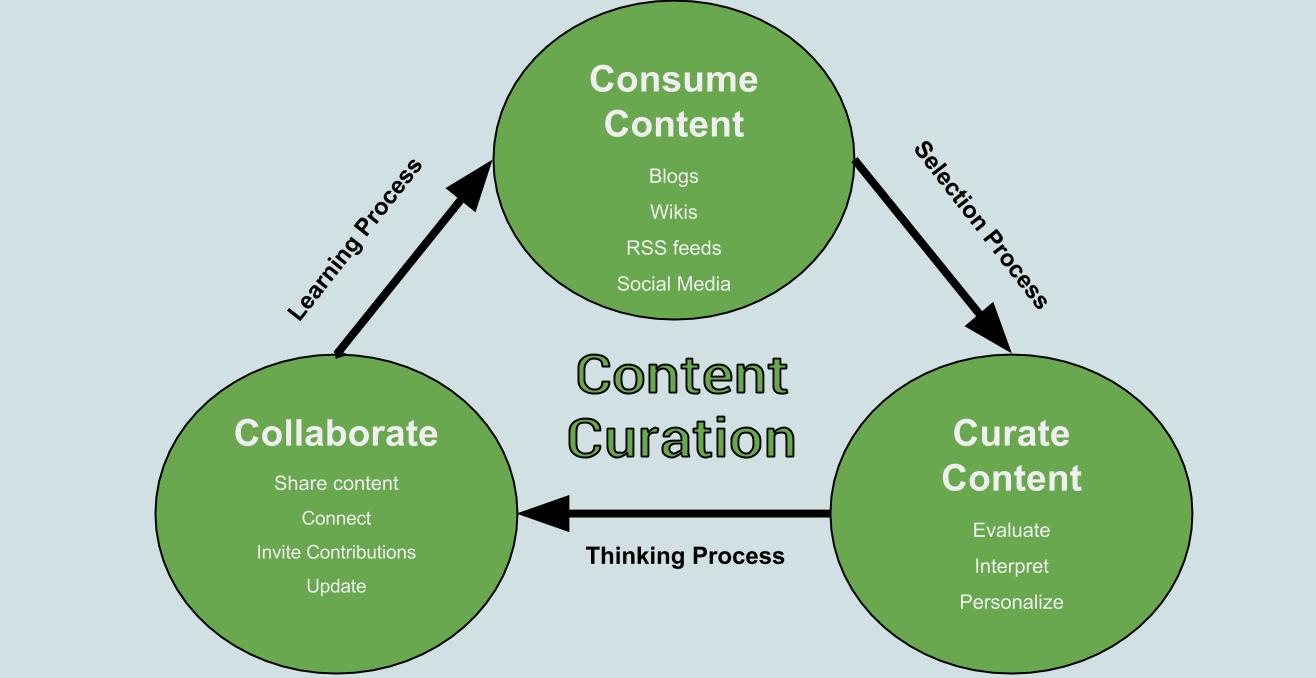
    Consume

    Between the dawn of civilization through 2003 5 exabytes of data was created…

    but that much information is now created every 2 days, and the pace is increasing.

    – Eric Schmidt, Google.

    Online content can be viewed as a continuous stream of data cascading in front of our eyes like a powerful waterfall.  It is endless flow of user-generated content (blogs, video channels, social media platforms) and publishing (newspapers, websites) and it is ever increasing.  So how do we make sense of it?  Historically, we used search engines like Google, Bing, and Yahoo, but even with advanced search algorithms developed by these companies results are at best ineffective.  No algorithm can compete with the effectiveness of an individual who is knowledgeable in a particular content area, collecting relevant and meaning information on a specific topic, and sharing it with a like-minded audience.  Consuming information, for the benefit of deepening ones understand of particular topic, is best served manually rather than using automated practices such as search engines.

    Curate

    More than merely collecting content on a specific subject; to curate is to make sense of the information we consume online.  Strong curation involves carefully selecting content and evaluating it for a specific purpose, topic, or subject.  It also involves making decisions about what is and is not useful to deepening understanding of the subject.  Content deemed useful can then be customized and personalized, by the curator, by adding ones professional experience to enhance it before sharing that curated content with one’s learning network.  Curating is a higher-level thinking skill.  In order to curate content that is useful for others the content needs to be synthesized, evaluated, and interpreted before being disseminated.  Well curated topics and subjects help to inform and allow learning to happen at faster rates.

    Collaborate

    Finding great content online is one thing, but being able to package it into a format that will help inform others is quite another.  Best practices on how to share content involve inviting others to contribute, disseminating curated content on a regular basis, and making sure that the content you share has been evaluated and meets the needs of your target audience.

     Once they find a quality, curated collection, they’ll stay for related offerings.

    – Steven Rosenbaum

    Difference Between Collecting and Curating

    Collecting                                        Curating

    – Independent                                                     – Shared

    – Lower-level thinking skill                            – Higher-level thinking skill

    – Consume content                                            – Add value and insight to content

    – Less organized                                                  – Highly organized

    – Closed learning                                                 – Open learning

    5 Great Content Curation Tools

    3 Examples of Content Curation

    1. Restorative Classroom Practices

    2. Self Regulation in Schools

    3. BC Education Daily

    Robin Good’s Video Playlist – Content Curation

    [youtube=http://www.youtube.com/watch?v=DMPSL-1qMG8&w=640&h=360]

  • Conversations In Ed: The Complexities of BYOD

    Bring Your Own Device (BYOD) agreements are being developed in many school districts across the province, and although they vary in content from district to district, there are many similarities. I am currently working on developing a draft BYOD agreement for my district and I wanted to take the time to share my learning.

    What are BYOD agreements?

    Agreements to support the use of student’s own devices in schools, to educate students and staff on the consenting use of devices, and explain the consequences of misuse of the networks which support the devices. There currently exists a wide range of different BYOD agreements; some brief and others extremely lengthy. It appears as though no one BYOD agreement is a best fit for all schools, so make decisions that best fit the unique needs of school or district.

    Why Do We Need BYOD?

    We are in a time when so much of the research, inquiry, and collaborative learning students complete in a day are enabled by the use of devices such as a smartphones, laptops, or tablets. Schools and school districts do not have large enough technology budgets to accommodate the seer volume of devices required, so a well thought out BOYD agreement would enable students to engage in 21st Century Learning, and at the same time alleviate some of the budgetary concerns facing many schools. In addition, it is important to acknowledge the efficiency benefits of BYOD agreements. Without BYOD, students may need to spend unnecessary time learning unfamiliar software programs pre-installed on school devices before they are able to complete the required learning task. In contrast, students who are permitted to bring their own devices to school are already familiar with them and can attend to the learning task right away.

    “By allowing students to bring in their own devices for learning–rather than insisting that they learn both content and device in school–there is an important opportunity to connect with not just their personal lives, but their natural way of doing things.” Terry Heick (teachthought.com)

    Pros:

    1. Students are familiar their own devices and can concentrate more on creating, responding to, and reflecting on their learning, rather than learning how to use unfamiliar devices and software
    2. Helps to address the problem of schools trying to provide the necessary hardware for 21st Century learning with limited technology budgets by allowing students to bring their own devices to school
    3. Excellent learning tool to gain access to information, create content, respond and reflect on own learning
    4. Potential to widen the student learning networks from traditional classroom based networks to global networks

    Cons:

    1. BYOD does not address the equality differences between students and schools residing in low socioeconomic areas
    2. Theft and misuse of devices
    3. Time and money spent on educating users on device etiquette
    4. IT and network considerations

    Communication

    It is critically important to clearly communicate the rationale of BYOD with all partners in learning; students, teachers, parents, and guests. Including the BYOD in a general acceptable use policy (AUP) is one option, but a more targeted approach might be more successful. Listing the BYOD agreement on the school district website, emailing it out, or adding it to each students’ school registration process might be more beneficial.

    Education and Training

    Teachers, support staff, and students may need ongoing training with the decision making process of when and when not to use devices to enhance learning. It is also important to spend time educating students on device etiquette. Students may not be able to establish boundaries between work and play. Educators use a variety of expectations around device usage in their classrooms, some of them include:

    • Silent mode unless being used
    • Device stays in the backpack unless a member of staff asks you specifically to use it
    • Students must not use devices to record, transmit, or post photographic images or video of a person or persons on campus during school hours or during school activities, unless otherwise allowed by a teacher – see more
    • Students should only be using the devices to access files, information, images, or video that are directly related to the content of the lesson or assignment

    Network Access Requirements

    It is important to clearly communicate what type of devices are permitted under your BOYD agreement: smartphones, tablets, netbooks, and laptops, and what the minimum hardware/software requirements are needed to gain access to the network. No teacher wants to spend their morning trying to get an outdated netbook connected to the school wireless.

    District/School IT Responsibilities

    In my school district when I, or when students in my class, have hardware/software issues we submit an IT helpdesk e-ticket, but what happens when the number of devices in my class increase with BYOD? Will the IT department be overwhelmed with additional requests? Will the IT department be expected to provide students with service level agreements? What will happen when student data is lost, and will more infrastructures be needed in school? I think students will need to charge their devices in the middle of the day, and schools/districts may need to consider charging stations at some point in the future.


    Network Security:

    Network security is an important feature of BYOD. We asked ourselves questions such as, how will you manage the network with respect to restricting access to certain sites at certain times? Would we continue to use Ministry filters from PLNet, or would consider using our own internal knowledge to program our own filters?

    Another questions raised by middle/high teachers were related to bandwidth. In one particular school, the WiFi bandwidth was seriously impacted as soon as buses started to arrive at school. As a 1000+ students started to walk through the doors and their phones started to auto detected the network, the network slowed to a crawl.

    In our discussion we decide to limit the number of devices a student can use to connect to the network, block certain sites during recess and lunch, and have several different wireless networks in school to accommodate different users such as staff, students, and guests. We are currently looking into Bradford Networks to assist us with providing the software to manage our networks. They will be able to register IP address, track infractions, block access to network and sites, and manage security threats.


    Unanswered Questions of BYOD Agreements

    Along the way to developing an agreement, we came across many questions we have yet to decide solutions for. For example, what happens if a device is lost or damaged on school grounds? Who covers the cost of fixing the problem or replacing the device? Schools simply cannot afford to replace the cost of damaged devices, so the sole responsibility needs to lie with students, but will this result in students, who have devices, deciding not to bring them to school in fear of damaging? Perhaps students will need to purchase a type of insurance to cover the costs of damaged devices in schools.
    What happens to students who misuse the networks they are accessing?
    Will sites be blocked during recess and lunch? If so which ones, and will this decision be made at the district or school level?
    Will a BYOD agreement mean unexpected and additional work by IT departments?


    Sample BYOD Agreements:
    http://education.alberta.ca/media/6749210/byod%20guide%20revised%202012-09-05.pdf
    http://www.allenisd.org/cms/lib/TX01001197/Centricity/Domain/1654/BYOD.pdf

    Great BYOD Links:
    http://www.teachthought.com/technology/11-sample-education-byot-policies-to-help-you-create-your-own/
    http://www.classlink.com/wp-content/uploads/2012/09/BYOD-Guidebook-v13.pdf?9e9d1c
    http://www.educatorstechnology.com/2012/07/what-teachers-need-to-know-about-byod.html
    http://dangerouslyirrelevant.org/2013/06/we-have-a-byod-program-but-now-what.html
    http://darcymoore.net/2013/06/04/byod-in-a-post-der-world/
    https://www.diigo.com/user/cyberjohn07/BYOD
    http://www.bradfordnetworks.com/
  • What Does It Mean To Be An Open Educator?

    In my last #tiegrad class we discussed what it means to be an open educator.  Since then, I’ve been developing my own understanding of ‘open practices.’

    [youtube=http://www.youtube.com/watch?v=2Wr2-hFxKBU&w=640&h=360]


    [youtube=http://www.youtube.com/watch?v=Rb0syrgsH6M&w=640&h=360]

    According to Wikipedia:

    Open education is a collective term[1] to describe institutional practices and programmatic initiatives that broaden access to the learning and training traditionally offered through formal education systems. The qualifier “open” of open education refers to the elimination of barriers that can preclude both opportunities and recognition for participation in institution-based learning. One aspect of openness in or “opening up” education is the development and adoption of open educational resources.”

    My understanding of Open Education is that it represents a mindset – a way of thinking of others instead of ourselves.  Educators who engage in ‘open practices’ create a culture of sharing, collaboration, and cooperation.  They work together toward a common goal.  Each one offering a unique perspective, or enriching the process of collaboration with their past experiences and knowledge.  It can start local with team teaching or grade group collaboration within a school, or it can extend beyond the boundaries of the school to the virtual world.  Massive Open Online Courses (MOOC), for example, are readily available online, and cater to a variety of subjects areas and topics.  These courses allow learners to connect via the web, share their knowledge, and better their understanding of the subject matter being discussed.  There exists technologies, which allow educators to connect in more informal ways but many of them are hidden behind passwords and usernames.  When we adopt a mindset of open practices, as educators, our practice can flourish and our students thrive.

    One of the most exciting aspects of open education, as it relates to my own practice, is the ability to participate in my own personalized professional development.  I don’t always feel like I connect to the professional development opportunities that my school district hosts or those offered by my school, but I do get excited knowing that I can connect with other educators in subject areas of interest, and create, share, and adapt content, which I can then used to enhance the learning experience I have with my students.

    Open Education also has real and meaningful impact outside of my own classroom practice.  It has huge implications from a social justice perspective.  I spend a lot of time engaging my intermediate students in service-learning projects that help them to understand, and create awareness around, local and global issues.  Our many discussions over the years always lead back to the root cause of many social justice issues, education.  Institutional-based education is not readily available for many children around the world, particularly girls, so access to education via the Internet is critical to helping us solve this problem.

    What Limits Open Practices?

    Closed practice educators may be more concerned about claiming ownership of knowledge, protecting intellectual property, or simply feeling like they have nothing to offer others.  I get it!  It is not easy to be publicly visible about your practice because you open yourself up to the possibility of criticism and critiques.

    Fear can also limit open practices.  Recently my school district adopted Sharepoint as tool to better connect students and teachers in the district.  It is a step in the right direction but the tool is only really meaningful in the closed environment of our school district.  It’s not possible to share documents, and create content with anyone outside of our group.  Why?  Perhaps schools feel anxious about privacy and the potential dangers of open practices, or maybe they feel the need to exercise control over knowledge and information.  My students can definitely learn a great deal from the skilled students and staff in the district, but I am certain they can learn an awful lot from those outside of my district, as well.

    What Tools Do Open Educators Use?

    Educators who engage in open practices often need specific tools to help them connect with like-minded professionals.  Some of these tools may be described as Open Educational Resources (OER’s).  In order for an educational resource to be classified as open, it needs to meet four key criteria.  OER’s need to be intentionally created for others to redistribute, reuse, revise, and remix.  Creative Commons work meets many of these requirements.  Unlike a research paper or a textbook, which is created once and is static, OER’s are dynamic.  They are always a continuous work in progress; much like the educator I strive to be.

    Keywords relating to the topic of Open Education:

    MOOC – Massive Open Online Course – MOOC List

    OER – Open Educational Resources

    #ETMOOC – Educational Technology Massive Open Online Course

    #openedu – Open Education Twitter hashtag

    #ceetopen – Community of Expertise in Educational Technology

  • What Do We Need In Order To Create Change In Education?

    BE THE CHANGE


    I don’t claim to have any answers to the above question, but when Heidi (@h_james18) from my #tiegrad Master’s class asked this question on Twitter recently, my mind began to wander.

    When I’m wrapping my head around big picture ideas it sometimes helps to look at the situation from the opposing direction. With that in mind, I think I know what we don’t need. We don’t need sweeping changes laid forth by a panicked government trying to play catch-up, nor do we need top down directions from our school districts, and I’m pretty sure that throwing money into technology for technology’s sake isn’t the answer either.

    Maybe we need to start small… We can’t change the face of education tomorrow, next month, or even next year so let’s not panic! A little self-talk for myself there… We can, however, start to make small changes by connecting, and sharing ideas, with like-minded educators in our buildings, our school districts, and our learning networks.

    I think we need to become creative at finding the necessary time to connect. Time, built into our daily work schedule, where we can meet with colleagues and grade groupings to hash out best practices and create authentic learning opportunities for our students, outside of the four walls of our classrooms. In Will Richardson’s book, Why School, he talks about the importance of unlearning and relearning in our teaching practices. Unlearning and relearning doesn’t always happen in the confines of our four classroom walls, nor does educational change.

    Most importantly we need the confidence and the support to make changes in our own practice. Change not for sake of it, but change based on empirically sound research. We need to practice in ways that students learn best. Tom Schimmer, a BC educator and an expert on assessment, talks about the four stages of changes; new ideas start off being marginalized, then ridiculed, often criticised, before finally being accepted. It serves as a good reminder for me that we need support for educational change to take place.

    What are the impediments to educational change?

    I suppose this could be a standalone topic by itself… Sometimes I think students themselves may represent impediments to change. I wonder if they have the skills to fully embrace a model of personalized inquiry-driven learning? I know so many of the students I work with have become so ingrained with the stand and deliver model that there is sometimes confusion or anxiety toward a different approach.

    Could our school buildings be impediments to educational change? Sometimes, I wish I could knock down the classroom walls and join my kindergarten buddy class for the day. Would a major restructuring of the physical space in our schools send a clear message that we value multi-age working groups that are based on interest level over groupings based on age and associated grade level?

    Are our current data gathering and reporting methods impediments to change? When I am required to give my students a standardized math assessment at the beginning of the year that I know full well they are going to bomb, I question the validity of some of our methods of gathering data. When students are excited to receive their report card, not to celebrate the learning that has taken place or hear about areas of growth, but to count the number of A’s and B’s they received, which they can later transfer into cash from their parents, there is a clear problem.

    What are you thoughts on educational change and its forces of resistance?