Blog

  • EDCI 338: Media Clip on Research Background and Interests

    This post marks the start of a new educational related journey for me.  I’ve decided to go back to school and further my understanding of the best practices available to engage and motivate my learners.  I’m part of a small cohort #tiegrad and our first assignment is to create a media clip based on our educational interests.
    [gigya src=”https://s3.amazonaws.com/boos.audioboo.fm/swf/fullsize_player.swf” flashvars=”mp3=https%3A%2F%2Faudioboo.fm%2Fboos%2F1609093-edci-338-media-and-personalized-learning.mp3%3Fsource%3Dwordpress&mp3Author=Mr_Lister&mp3LinkURL=https%3A%2F%2Faudioboo.fm%2Fboos%2F1609093-edci-338-media-and-personalized-learning&mp3Time=09.54am+18+Sep+2013&mp3Title=EDCI+338+-+Media+and+Personalized+Learning” width=”400″ height=”160″ allowFullScreen=”true” wmode=”transparent”]

    I’ve been involved in education in Chilliwack since 2007 and I currently work at Central Elementary Community School.  I am looking forward to the program but I am a little nervous about being able to juggle life, work, and school, especially with my first baby on the way.  The last few years have been extremely satisfying as an educator.  I’ve have started to develop a voice in education, continually try to improve my craft, and started to myself questions like, “What kind of learning environment am I creating?” “Does the activity I’m asking students to do relate to the learning outcome?” and “Am I feeding my students knowledge or posing questions to which we can discover the answers to together?”

    I have several areas of interest I’d like to share with.  One area of interested is a part of my weekly schedule I have coined CHOICE – Children Have Ownership In Choice Education.  You might know it as genius hour, enquiry learning, or personalized learning.  I think it’s important to create time in the weekly schedule where students are encouraged to find their passions and explore them.  During CHOICE, I don’t plan to have too many answers for students, but plenty of questions.  I can visualize what it looks like, to some extent, but I’m having difficulty creating a framework to suit all my learners.  I wanted to include it in my schedule last year but couldn’t find the right time.  Perhaps the right time is not when everything is aligned, but now.  I read Will Richardson’s book “Why School?” last year and I loved Larry Rosenstock’s quote:

    “We have to stop delivering the curriculum to kids.  We have to start discovering it with them.”

    I get it!  It makes sense to me, but I still wonder what it looks like for all my students.  I am looking forward to reading Angela Maiers, “The Passion-Driven Classroom” which I believe speaks to this type of learning.

    Another area of interest to me is self-regulation.  I work in an inner-city school with a disproportionately high number of at-risk children.  Many of these children are either too stimulated or not stimulated enough to partake in the learning process.  The need to develop students’ ability to self-regulate has become glaring obvious to everyone who works in my school, so this year I’m working with a new program called MindUP curriculum developed by the Goldie Hawn Foundation.  MindUP teaches social and emotional learning skills, brain science, a positive mindset, and mindful awareness.  Right now we’re working on deep breathing techniques, and will soon be learning about important parts of the brain, and how signals in our brain get blocked during times of stress and over stimulation.

    I‘m an avid Twitter user and have found real value in Twitter over the years, particularly when developing learning networks, making connections, and working to improving my craft.  I like to explore student-learning networks in more depth.  The thought of my own students making connections with other students, teachers, professionals from around the world who work in fields they are interested in excites me no end.  I’ve tried them with students with mixed success but never with a whole class.

    Game-based learning is an area of education that fascinates me.  I’ve just finished reading Now You See It by Cathy Davidson and in her books she talks about designing lesson in a gaming format where lessons allow for risk taking, meaningful creation, nonlinear navigation, problem solving, and an understanding of rule structures  So many of my students play video games and are engaged, motivated, and incredibly creative with them.  Nothing would please me more than to transfer some of those experiences into the classroom.

    Finally, I have to let you into a little secret.  All the areas of professional interest I’ve mentioned already pale in comparison to what gets me up in the morning.  Four years ago I took my grade 6’s to Free The Children’s We Day in Vancouver, and that one experience change my views on education and what’s really important in school.  Building positive healthy relationships with one another, exercising tolerance, forgiveness, and above all else caring for one another is what really matters.  Thanks to We Day, my classroom has become a hub for social justice issues both globally and locally.  We fight hunger, stand against inequality, educate our local community about homelessness and water issues, and advocate for human rights.

    I look forward to learning and sharing with you.
  • Student Vote: Giving Youth A Voice

    Photo 2013-05-05 07.49.37 PM

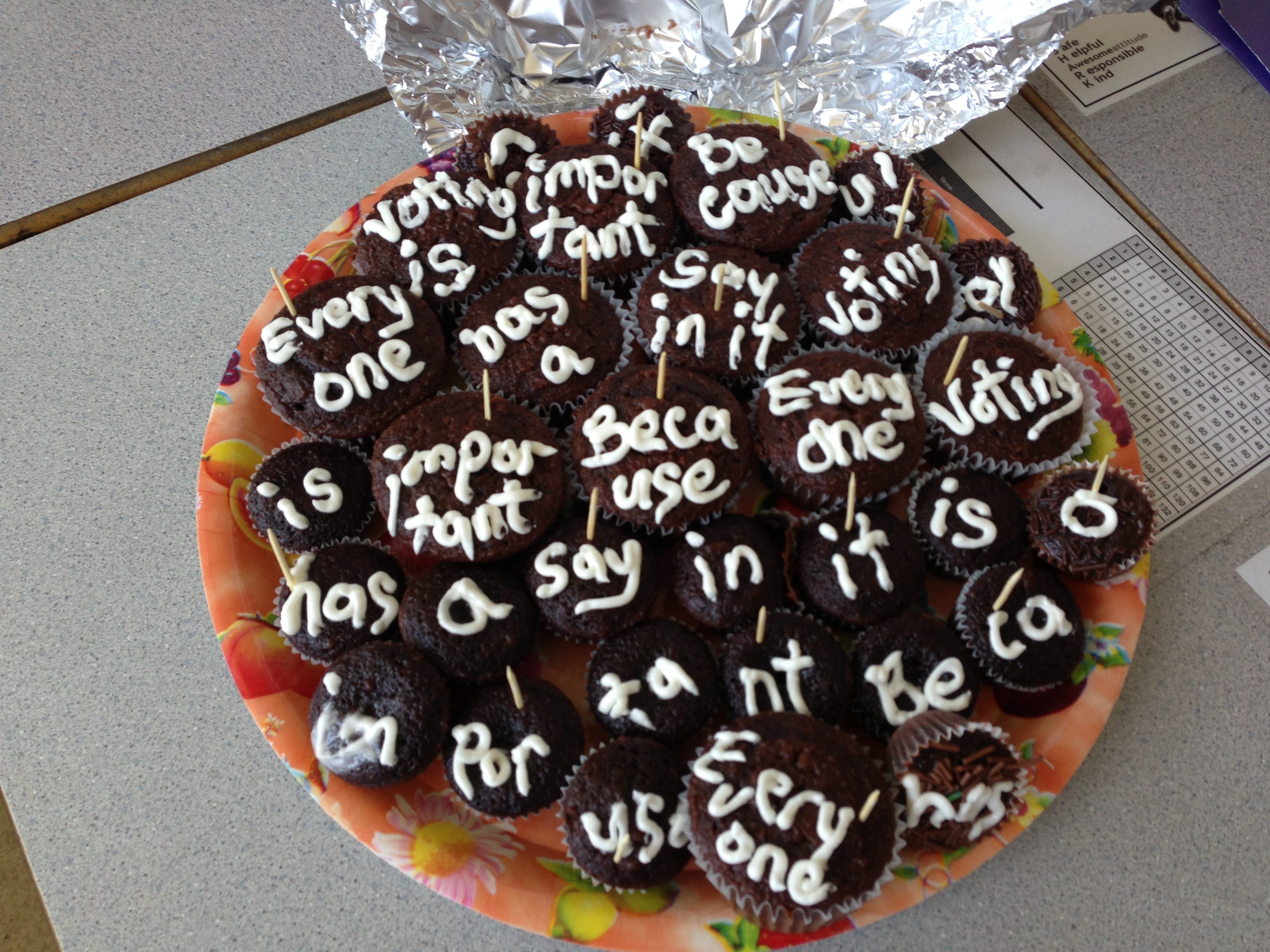
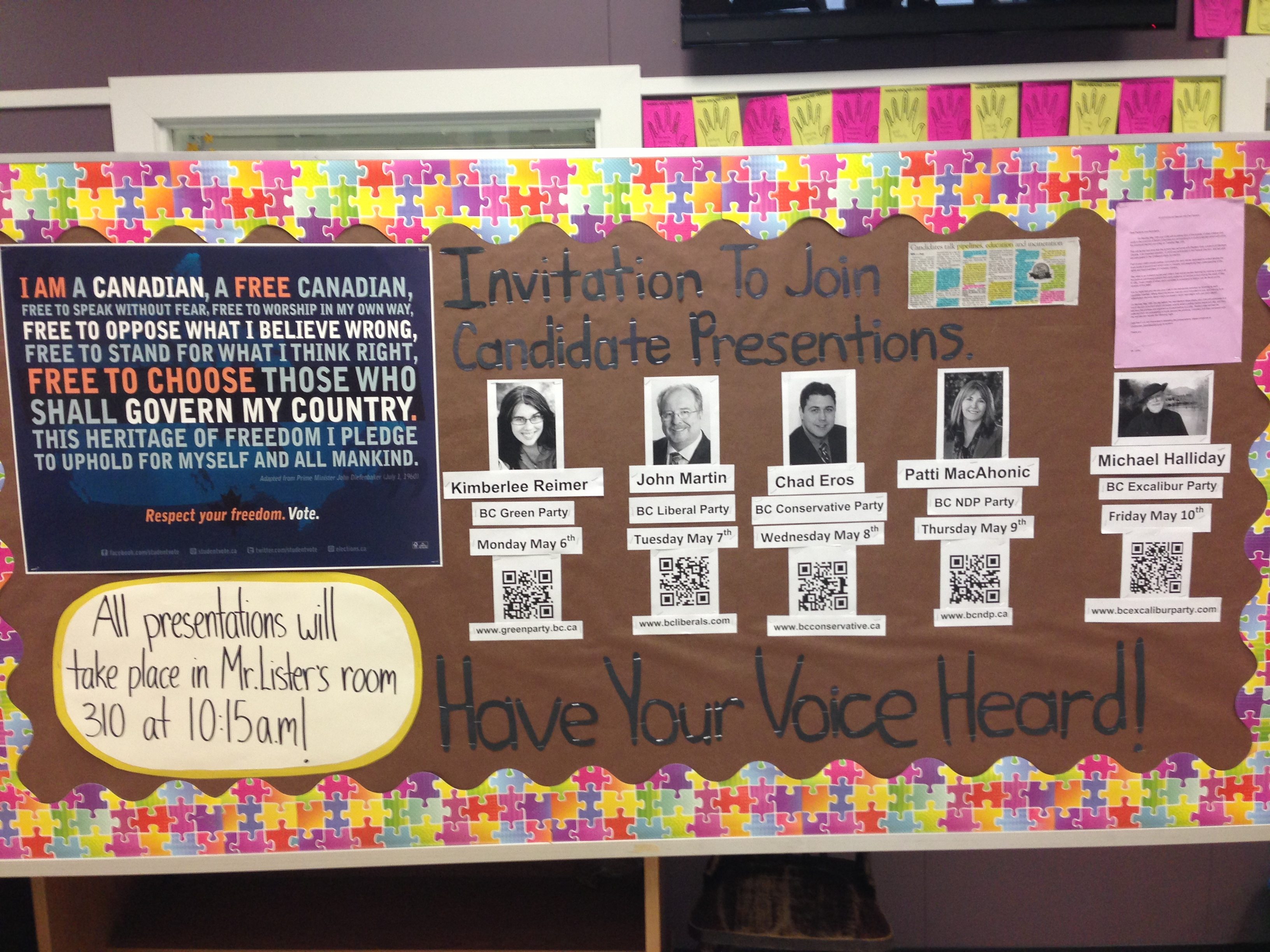
    It is never too early to empower our youth.  As an elementary school educator in Chilliwack, British Columbia I have been involved with Student Vote for 4 years.  In 2009, my principal at the time called me into his office and handed me a box that he had ordered from Student Vote and asked me if I wanted to run an election with my grade 5-6 class.  In the back of mind I could hear my dad’s familiar rhetoric, one he used to inspire my siblings and I around voting time, “Women chained themselves to fences for the right to vote…” He was trying to impress upon me the need to honour those who have gone before me in the struggle to have their opinions recognized.  I took the package from my principal and started a journey to demystify the election process and remind my students that their voices need to be heard.

    My students and I have now participated in the 2009 provincial election, the 2010 federal election, the 2011 Chilliwack-Hope by-election, and will be joining thousands of schools voting in the 2013 Provincial election.

    When I host an election at school, I like to invite all candidates to present to my students before they make their final decision on student voting day.  If you are considering hosting a Student Vote election I would say the opportunities for authentic learning experiences are second to none.

    Here are my top 9 tips for hosting a Student Vote election:

    1. Contact candidates early – their schedules can fill up quickly

    2. Stop by campaign offices and introduce yourself.  Candidates are more likely to agree when they hear you are reminding students of their rights and responsibilities as Canadian citizens

    3. If you need contact information for your candidates try contacting your local newspaper

    4. Use Ustream to stream your presentation live to participating schools in your riding

    5. Encourage parent participation by inviting them to watch the candidates speak.  Here is a sample letter I sent out this year

    6. Engage your students in the process by collecting campaign materials and information on party platforms

    7. Debrief what each candidate has spoken about and display the information so students are able to make their final decision

    8. Recreate a polling station in your classroom/school and have your students use election resources like privacy screens, ballot boxes and ballots to recreate voting day

    9. Compare and contrast the results of student voting day to actual results in your riding

    Student’s getting excited about the election buzz:

    Photo 2013-05-05 07.45.47 PM

    Photo 2013-05-05 07.46.45 PM

  • “We have to stop delivering the curriculum to kids.  We have to start discovering it with them.” – Will Richardson.

  • Conversations In Ed: Year End Awards

    “Dangling awards in front of children are at best ineffective, and at worst counterproductive.” – Alfie Kohn.

    Have you considered the merits of your school’s year end award ceremony?

    The realization that I needed to think about trying to change the culture of my school, with respect to awards, hit me square in the face during one of our assemblies.  One morning, in the middle of the school year, the principal was making her way through the staff asking them to announce their ‘Fintastic’ winners of the week.  Fintastics are tickets given to students who are caught doing good deeds around the school, and are part of our school’s PBS Positive Behaviour Support System.  The lucky student’s name was called out, and that student headed to the front of the assembly to be recognized, by the entire school, for being ‘Fintastic.’  Sadly, not a single explanation was given as to why we were recognizing each student, except for the fact that at some point in the last week they were caught doing something ‘Fintastic’.

    This educational epiphany forced me into thinking differently about student motivation, which in turn led me to think about awards and student achievement at my school.  Research and numerous studies conducted by social psychologists show that the act of catching someone doing something positive and rewarding them for it in the shape of a token, gift, prize, or ‘Finatatsic’, can actually be detrimental to the type of behavior you are trying to recognise.   Thanks to Daniel Pink, Sir Ken Robinson, @chriswejr, Alfie Kohn, and @gcouros I have been able to develop my own educational voice in this area, which led to some conversations in my school about changing how we recognize students, starting with end of the year awards.  It’s this experience that I want to share today.

    [youtube http://www.youtube.com/watch?v=u6XAPnuFjJc]

    In my school, at the end of the year, it is the culture to award a myriad of certificates, medals, and trophies to grade 4, 5, and 6 students in areas such as Athletics, Service, Citizenship, Abundant Asset, Proficiency, Academic Excellence, A and B Honours.  I have come to realize that there are more beneficial ways to recognize student achievement.  Ways that show appreciation for all students instead of a selected few.  Ways that promote community building and avoid focusing directly on the individual academic achievement.  During our end of year awards ceremonies I have noticed the same student’s names appear beside each award, year after year.

    All students contribute in some way to developing and maintaining a strong and inclusive school community, and as educators, we should be able to recognize each and every student for their individual contribution to the success of the year.  In essence, award ceremonies, like the ceremonies that happen in my school and many other schools around the world, say that we only care about high achievers.  In a class of 30 children when four are recognized for achieving high academic success, how do the other 26 children feel?  Probably like their year was a waste of time.

    There exists an extensive amount of research which shows that extrinsic rewards, such as stickers, trophies, medals, and certificates can be damaging to students’ intrinsic desire to learn for learning’s sake.  It has been proven time and time again in countless studies over the last half-century that when students are rewarded for achieving certain goals, they perform less efficiently than those who are not rewarded.  The rewarded, tend to think less creatively, have a ‘reach the goal at any cost’ mentality, are motivated to work individually instead of collaboratively, and are often so focused on the prize they become closed off to alternative methods of reaching the goal. (Kohn, 1999)  In a time when we are trying to produce collaborative and creative workers for the work force, it seems counterproductive to continue to offer rewards in ways we currently do.

    My Experience With Opening Up Discussions Around Awards and Rewards

    The Conversation and compromise:
    Towards the end of the school year I sat down with my principal and explained how uncomfortable I felt about only recognizing a select few students at the year end award ceremony.  I went on to explain that it felt disrespectful towards the rest of my students.  Each and every one of my students had made a positive contribution to the classroom community, and I felt the need to recognize them all, individually.  She agreed that the current method of celebrating selective students at the end of the year probably wasn’t the best.  We discussed increasing the number of awards, expectations of parents, expectations of students, and the effort required to change the school culture.

    In the end I agreed to participate in the regular year end awards ceremony with some minor alterations, but then recognise my students, after the awards ceremony, in a more respectful and holistic way.  I felt confident, after our discussions, that together we could start to slowly change the culture of award ceremonies.

    After the award ceremony, I invited all of my student’s parents to attend one last class circle, where I would recognize all my students, individually, for their contribution to the classroom community.  Before I started the circle, I explained to everyone present that this was an appreciation circle; a chance for me to reiterate how much I appreciated each student’s contribution this year.  When giving feedback, I tried to give specific examples to make the feedback more meaningful.  After I had finished with each student I gave them a card which repeated, in writing, exactly what I’d said orally.  The feedback I received from the parents that attended was overwhelmingly positive.  Even those parents whose children had, earlier in the day, been draped in medals and presented with numerous certificates, understood the value in the process.  More importantly, every student received a piece of oral and written feedback thanking them specifically for their contribution.

    Goals For The Upcoming School Year:
    My goal for this year is to continue to have meaningful and productive conversations with admin, PAC, parents, and students around more effective ways to celebrate student achievements, particularly at the end of the year.  As I did last year, I will host a final year-end circle in my classroom and invite all parents to attend.

    Develop A School Culture That Recognize Every Child For Their Contribution and Their Efforts:
    In the future, it is my hope that the culture of the school begins to recognize all students for their individual achievements throughout the year, and we no longer use the last official assembly of the school year to recognize a selected few.

    I would welcome the opportunity to continue learning about how others recognise and celebrate student success, so please feel free to interact.

  • Two Great Ways To Improve Blogging In The Elementary Classroom

    1. Edublog’s Student Blogging Challenge

    http://studentchallenge.edublogs.org/

    This is a 10 week challenge facilitated by Edublogs and is designed to improve the quality of your student’s blog postings, give a framework for leaving quality comments and offer an opportunity for students to connect with other students from around the world.

    The challenge occurs twice a year in September and March.

    Steps to participate:

    • Register your intent to participate.
      • Classes register here
      • Students register here
    • Register your email address with Edublogs here so you can receive weekly blogging challenges directly to your (or your students) inbox.
      • You can do this by entering your email address in the top right hand corner of the Student Blogging Challenge website under the heading, ‘Subscribe For Free.’

    Students who use class blogs (teachers blog) are just as welcome as well as those who have individual blogs.

    2. Quadblogging

    http://quadblogging.net/

    Quadblogging is designed to increase the amount of traffic to your student’s blogs, enabling them to write for a wider audience.  It also enables students to connect with teachers and students from around the world.  Opportunities like these really open up your classroom to global perspectives.

    Steps to participate:

    • Sign up here.
    • Keep up with tweets @Quadblogging.
    • If you choose to lead a quad, then once you have been assigned your group, you will need to contact the other three schools and arrange a start date.
    • If you choose not to lead a group, once you been assigned a blog, wait for the quad leader to contact you.
    I share the following two documents with my students which are designed to improve their blogging and commenting skills.  You may find them helpful with your students:
    I Can Statements: Blogging
    I Can Statements: Commenting


    If you chose to take part, then please feel free to let me know how the project(s) went for you.  Also, if you are aware of any similar projects please leave a message in the comments section.

  • Conversations In Ed Series #1: Advocating For Co-Ed Sports Teams:


    This post is the start of a series of postings which are designed to create conversations on a variety of educational topics. Feel free to add your thoughts in the comments section.

    I have been thinking about this topic for a couple of years, because I have yet to hear valid reasons for segregated our students when they play on school sports teams?  Is it really necessary to separate girls and boys for team sports, at the elementary level?

    Developing co-ed sports teams at the upper elementary level can create more harmonious classroom relationships between girls and boys, and may even lead to a deeper sense of gender equality later in life.  Those that play together learn to live together. I have often been dismayed by the lack of respect boys and girls show each on the playground, occasionally in the classroom, and frequently on the field of play. These offences are usually gross-generalizations passed down through generations. I have lost count how many times I have heard these quiet murmurings on and around the soccer, “They are just girls,” “We should score lots of goals today, they have girls on their team,” “You can’t skip with us you’re a boy.”

    I have heard the argument that the physical differences between boys and girls should be reason enough to separate them, but I disagree.  In my experience, boys and girls aged 10, 11, and 12 (the age which students in my school district typically join sports teams) are very similar in bodyweight and height. Sure, there are times when the opposition towers over my smallest boys and girls, but they know its safe to play and nobody will intentionally hurt them.

    Playing on co-ed teams teaches children to be more socially responsible.  One of our school’s goals is social responsibility. We learn social responsibly in different ways throughout the day, and one way is through play. What better way is there to learn these skills, in a truly authentic way? The power of a great play between a boy and girl on the soccer field cannot be understated, especially when that moment of mutual respect is later transferred to the classroom in terms of working together in harmony. I would even go so far as to say that later in life that single moment could lead to a deeper sense of gender equality.

    Our schools should mirror society’s move towards greater gender equality.  We don’t have public schools for boys and public schools for girls in British Columbia.  In fact, we activity encourage our students to work in mixed gender groups in the classroom, so why not on the sports field?  Working and playing with the opposite sex is a skill and a necessity in life.  The sooner we close the gap by developing co-ed teams at the elementary level the better.

    Is it really necessary to separate girls and boys for team sports, at the elementary level?  Co-ed teams foster a sense of mutual respect, they teach social responsibility, and they mirror what happens naturally in the classroom.

    Further reading on gender bias’ in education:

    View of single sex public education:
  • Could We Have Done Better?

    Could We Have Done Better?

    I work at the best school in the District.  In fact, I would go as far as to say that my school is the flagship school in the District.  Aside from the completely renovated heritage-style three storey school, the grounds are tastefully landscaped, and the exterior has been beautified in recent years with colourful murals which reflect our diversity and our community spirit.  The brand new enclosed hockey rink combined with a relatively new soccer field makes me proud when I arrive at work each day.

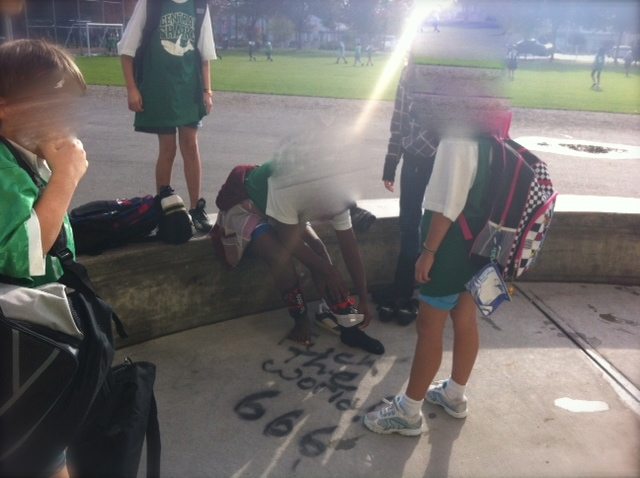
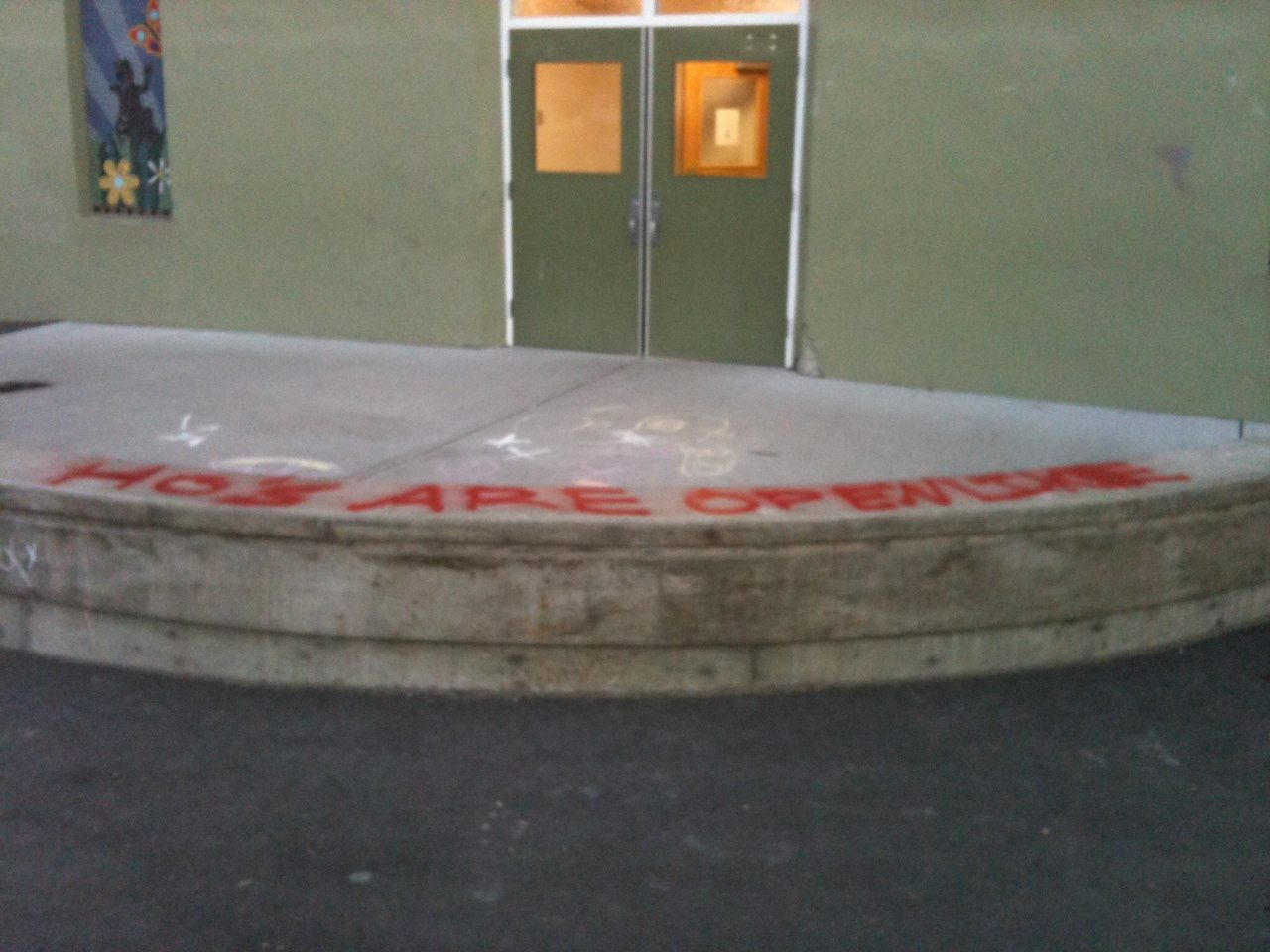
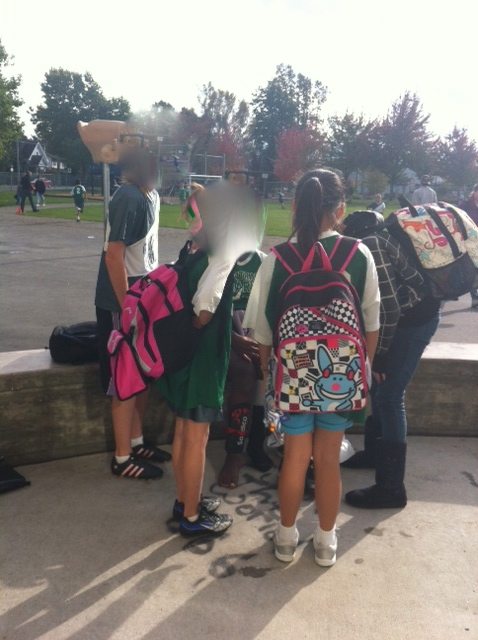
    You can imagine how I felt when, on Tuesday morning, I arrived at work at 7am to find three separate messages spray-painted on the concrete at the south entrance to the school.  I was outraged!  The messages read, “@#$% the world 666”, “We rule this town,” and “Ho’s legs are as wide as the hallways.”  I could not stand the thought of students seeing the messages when they arrived at school, so I covered them up with garbage bags and masking tape.  Shortly after school started, I used the experience as a circle discussion in class, which led to a writing assignment.  A selection of student writing can be found below.  I assumed that someone would be on their way to school soon to remove the paint.  I was wrong.  72 hours later, two of the three messages remained.  Not only that, but since Tuesday afternoon when the first message was cleaned, the other messages were uncovered and left visible for all to see.  Could we have done better?

    There exists an unfair stigma attached to my school.  Some people call it an inner-city school, others call it the downtown school.  In non-educational circles, it has been described as the rough school, and the troubled school.  It is a myth.  Granted, my school has its challenges, but the labels are unnecessary and unfair.  By not acting swiftly enough, have we perpetuated the myth?  A local elementary school visited our school twice this week for soccer games.  On both occasions parents, teachers, and students from the visiting school have accessed the south-entrance and encountered the disturbing messages.

    Students at my school are some of the most socially conscious students I have encountered in the District.  We engage our students several times a day on the topic of social responsibility.  It is even one of our school goals.  We use restorative circle practices, teach and reteach our school matrix, and have committed to a year-long program called, “Play Is The Way,” which teaches children social responsibly through play.  In a nutshell our students, and in particular, our grade 5-6 leadership students, have a good sense of right from wrong.  Could we have modelled a socially conscious attitude ourselves and worked to remove or cover up the messages so our students were not exposed to such filth?  Could we have done better?

    I wonder if parent pressure in a different school might have resulted in a quicker clean up effort of these disturbing messages.  If parents are not advocating for such things at my school, surely the school and the school district needs to be.  I am not aware of our District protocol for such events, but I would like to see it reviewed.  Disturbing messages need to be covered up before they are cleaned.  72 hours and counting, is too much time to deal with such issues.

    Letters written by our students:

    Vandalism
    Vandalism is impacting kids in many ways, and what just happened at our school is no acceptation.  Some of us think of school as home.  Meaning we’ve been here for a very long time and we feel safe here.  It gives the school a bad reputation.  When parents come to school with their kids, who are still very young, and it makes them think “wow what kind of community  would do something like that.”  It doesn’t feel very safe when you read some of the comments.   As in “_ _ _ _ _ _ _ was here” or “I’ll be back”  it scares kids.  And even for me it just doesn’t make the school feel like a safe place, like it should.  When I come to school and see nasty or rude or inappropriate writing somewhere where lots of people ( youth, elderly, etc etc…) can see it, I feel disgusted.  >:( – Bryanna

    Vandalism needs to STOP!
    Vandalism needs to STOP!  Vandalism is impacting our community.  They are writing nasty things to our schools.  Vandalism is a crime. It’s wrecking property.  It’s making other people want to do vandalism as well.  If you see someone do it then sometimes you feel like doing it to. it makes me feel mad. – Andy

    Vandalism needs to STOP!
    This “vandalism” needs to stop, because some people care about these places!Some people stayed at Central Elementary school for along time. kids don’t need to know these kind of words. That’s one of the reasons I don’t like school vandalism. I don’t like the idea that our school district has to pay for this “vandalism”. I think the people that did this, should pay for it, also pay the time for cleaning this mess up. I would be delighted, to know people are amazing enough to stop, this Vandalism! =:) – Jessie

    Dear Mayor Sharon Gates

    When I came to school and saw vandalism on the cement I know lots of people where impacted.  The children were impacted they see the things that were written.  If you think about it what if the little children see the vandalism and they say the words that they see.  Our custodian is impacted be cause he has to clean the it.  How do you think he feels when he can’t clean it because of the paint they used?  And the parents get impacted because their children go to the school that has vandalism on it.  The parents probably feel like something could happen to their children.  The vandalism makes me feel angry and it needs to stop. – Taylor

    Vandalism is wrong.  Little kids will be affected.  If it says bad words, little kids might say those words.  Vandalism makes the world look horrible.  Less people will want to go to that place.  Parents will be more protective of their children.  Parents won’t let their children to go outside very often.  Vandalism does not belong in this world. – Sereena

  • Two Ways To Engage In Creative Writing


    1. The Progressive Story Project:  My teaching partner, @missbartel, stumbled upon this project last year.  Both our grade 5/6 classes participated with enthusiasm in the spring, and engagement levels were high throughout.  The Progressive Story Project was developed by Karen Ditzler, an instructional technology specialist, from Pennsylvania USA.  Groups of 5 classes, in schools around the world, work together to write a complete story.  Here’s how the project works:

    • The first class brainstorms and writes the intro paragraph(s).
    • Then the next class reads the paragraph(s), brainstorms and decides how they want to continue the story.
    • This will continue until the last class on the list writes the ending and gives the story a title.
    • Classes can edit their section of the story on the Wiki.
    • Once your class has finished the writing part, students can choose scenes to illustrate from their writing.
    • Once all illustrations have been submitted, a VoiceThread is created of the entire story.
    This is a link to the story my grade 5/6 class created last spring.


    2. QuadBlogging:  The primary goal of QuadBlogging is to increase the flow of traffic to a class blog or a number of student blogs in a particular class.  The project creates opportunities for classes, in different school across the globe, to develop their blogging and commenting skills.  If you are familiar with the Twitter hashtag #comment4kids, then QuadBlogging achieves a similar outcome but in a more formal way.  Here’s how the project works:

    • School A becomes the focus school for an entire school week
    • Schools B, C, D spend the week visiting school A’s blog(s), leaving comments and interacting with the content of the blog(s)
    • In the second week of the project, school B becomes the focus school
    • Schools A, C, D spend the week visiting school B’s blog(s), leaving comments and interacting with the content of the blog(s)
    • During the third week of the project, school C becomes the focus school for the week
    • Schools A, B, D spend the week visiting school C’s blog(s), leaving comments and interacting with the content of the blog(s)
    • The cycle continues until all schools have had the opportunity to be the focus school.
    If you are aware of other ongoing projects, which attempt to connect teachers and students across the globe please feel free to add a link and the title of the project in the comment section below.
  • Tech Integration Post #10 of 10: Using QR Codes in the Classroom

    QR (quick response) Codes are like barcodes on steroids!  They enable anyone with a QR reader app on their smartphone/tablet to scan the code using the device’s onboard camera, which then creates a shortcut to a variety different links.  Shortcuts may include links to website address, email accounts, pictures, videos, audio files, maps etc…

    This QR Code links to a very informative Common Craft video which further explains QR codes:

    Before you can use QR codes you need to visit a website to build it.  Here are a list of sites used to create QR codes:

    Once you’ve created your QR code you should test with by using any of the free QR reader apps below:
    When I saw the picture below, on a remote stretch of northern California highway, I realized the true impact QR codes have on our society, and how useful they can be to develop a deeper understanding of a subject:
    Using QR Codes in the class:
    1. Self-guided tour of the school or the classroom:- QR codes could be place at key locations throughout the school and linked to an audio file which further explains the location and what should happen there.  For example, my school follows the EBS/PBS model for discipline, and one of the major components of EBS is the school matrix.  The school matrix outlines our code of conduct (Safe, Helpful, Awesome Attitude, Responsible, and Kind) and how it should be applied in various areas of the school (classroom, transitions, playground, assemblies etc…).  At the beginning fo each school year, or when new students arrive, QR codes could be placed in the above locations and linked to an audio files which would explain the matrix in detail.
    2. Student art gallery walk:- Any visual art lesson can be converted into a multimedia gallery type exhibition using QR codes.  For example, if my students are working on examples of op-art,  they can transform their 2-dimensional drawing into multi-sensory displays by attaching a QR code to the picture.  The QR code may then link to an audio file, which further explains the artwork.  In the audio file students can reflect on their work and use metacognition to express what was easy/difficult about the process.  They can also link their work to additional text and videos on the subject of op-art to encourage others to develope a deeper understanding of the concept.  Finally, students could assess each others work by recording feedback, creating a QR code and attaching it below the artwork.  Thus creating a comment section similar to a blog.
    3. QR Codes attached to homework:- Attach a QR code to your student’s place value homework which links to a video you made using Explain Everything (A video creation tool for the iPad).  The video can reinforce the skill of understanding the value of each digit in a number.  This has huge potential for occasions when support at home is not available.
    4. Guest Teachers:- Guest teachers who substitute in your room may feel more comfortable if they can follow some of the existing classroom rules/expectations.  QR codes could be place on the mobile computer lab, for example, to explain the rules of using the equipment.
    5. Student jobs:– In my classroom we share the responsibility for keeping the classroom clean and tidy.  QR codes could be place at various points in the classroom to reinforce what steps should be taken in order to make sure the bookshelf is fully cleaned, or to explain how to take attendance and where to take it when it’s completed.
    I would welcome any additional ideas you have on how to use QR codes in the classroom.
  • Tech Integration Post #9 of 10: Create Concept Review Videos For Students And Parents

    Throughout the whole of the previous school year, I often wondered how to reach more of my student’s parents and engage them (directly) in classroom concepts. I wanted to somehow have the ability to connect parents with what was happening in the classroom, and at the same time offer parents the opportunity to practice fundamental math concepts with their children, based on materials I had created for them.

    Originally I had planned to video myself explaining math concepts such as place value, number sense, addition and subtraction, multiplication and division. When I first tried to video myself I had to consider things like lighting and position of props. It turned out to be time consuming and somewhat difficult.

    Recently, I found a solution, and want to share it with you.  I use the iPad app, Explain Everything to create math review videos.  Explain Everything is an easy-to-use design tool that lets you annotate, animate, and narrate explanations and presentations.  It’s like an interactive whiteboard for your iPad! You can easily create dynamic interactive lessons, activities, assessments, and tutorials using Explain Everything.  It is possible to record your voice, add images, change pen colours and vary the thickness of your pen lines.  Not only that, but you can easily edit your video, and export to several different formats including, YouTube, Evernote, and email.

    The intermediate division of my school is going to be focused on improving math skills this year, and it is my goal to email or host these videos in a place for my student’s parents to view before school starts, during the first few weeks or school, and at any time a review is needed.  So, the next time a parent of one of your students asks, “What can I do to help my child with math?” send them a link to one of your newly created math review videos.  It’s that easy!

    Here’s a couple I made today.  Feel free to tell me what you think:
    [youtube http://www.youtube.com/watch?v=3LIDSY9lwxo&w=420&h=345]
    [youtube http://www.youtube.com/watch?v=f_cdWsxmYEk&w=420&h=345]

  • iPad + Blogsy: A Match Made In Heaven

    Updating your WordPress.com blog on your iPad, while travelling, has never been easier with Blogsy. There are many applications you can use to manage your blog on the go including, WordPress, Blogpress, Evernote, but I really like Blogsy and its ease of use.

    Before you begin blogging, you will need to purchase some additional hardware if you fo not plan to use the iPad’s built-in video and camera. If you have an additional camera you use to take pictures for your blog, or a video camera with more options you’ll need to purchase the Apple iPad Camera Connect Kit. This allows you to connect an external micro SD card or a USB device to your iPad. Once you connect the camera kit, the iPad will automatically import all video and images based on your preferences. It’s as simple as that. Once your media is stored on the iPad, you are ready to blog. It is also possible to add media via cloud picture albums such as Picasa Web Albums and Flickr without the camera connect kit. I’ll explain this later.

    Once all the media (pictures and video) which you intend to use in your blog posting has been transferred to the iPad you can begin to interact with Blogsy. Before you create your first blog you will need to customize Blogsy. It doesn’t mater which of the three main blogging platforms you use, WordPress, Blogger, or Posterous. You will be able to use Blogsy’s easy to use interface to post content to your blog. Here is a useful video that explains how to complete Blogsy’s ont-time set up for your blogging platform:
     

    [youtube=http://www.youtube.com/watch?v=4WAXGmnyEP8&w=640&h=390]

     
    Assuming, when about to blog on the go, that you don’t have access to cloud photo albums, Flickr and Picasa Web Albums, you will to transfer media (both still pictures and video) from your SD card to your iPad. This short video explains how to do this with the aid of Apple’s Camera Connect Kit:
     

    [vimeo http://www.vimeo.com/28025151 w=640&h=360]

     
    Once you have transfered all your media to the iPad, you can write your post in full and publish to your favourite blogging platform. This short video explains how to add media to your post, apply appropriate categories and tags, and publish to the Internet:
     

    [vimeo http://www.vimeo.com/28025151 w=640&h=360]

     
    I recently created a blog on the iPad using Blogsy. It’s as easy to blog on the iPad as it is on a laptop or desktop. By clicking on the link you can see the quality and variety of the postings on my summer cycle tour along northwestern coast of the U.S.A. All posts were created and published on the iPad.